Description
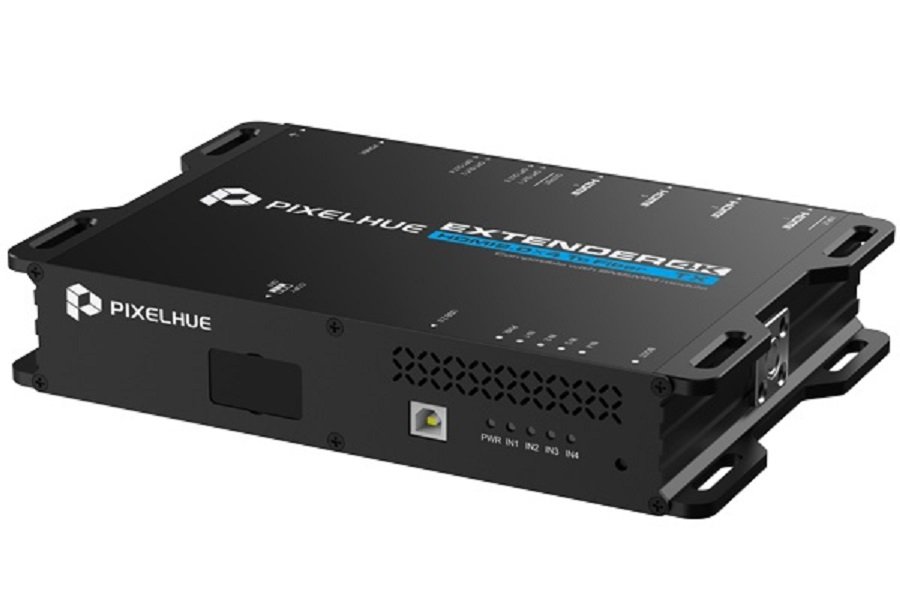
The Pixelhue EP4T is a high-performance fiber optic video transmitter/extender designed to send 4K Ultra HD video and audio signals over long distances using optical fiber cables. It’s widely used in professional AV installations, broadcast studios, large-scale events, digital signage, monitoring centers, and conference systems where traditional copper HDMI/SDI cables cannot reach or maintain signal quality over long runs.
The Pixelhue EP4T is a professional fiber optic HDMI video transmitter. It’s used to send high-resolution HDMI video and audio over optical fiber instead of traditional HDMI cables. This allows signals to travel much farther with better quality and no interference, which is especially useful in broadcast, event production, large venues, conference spaces, and digital signage.
Key Features
Inputs & Outputs
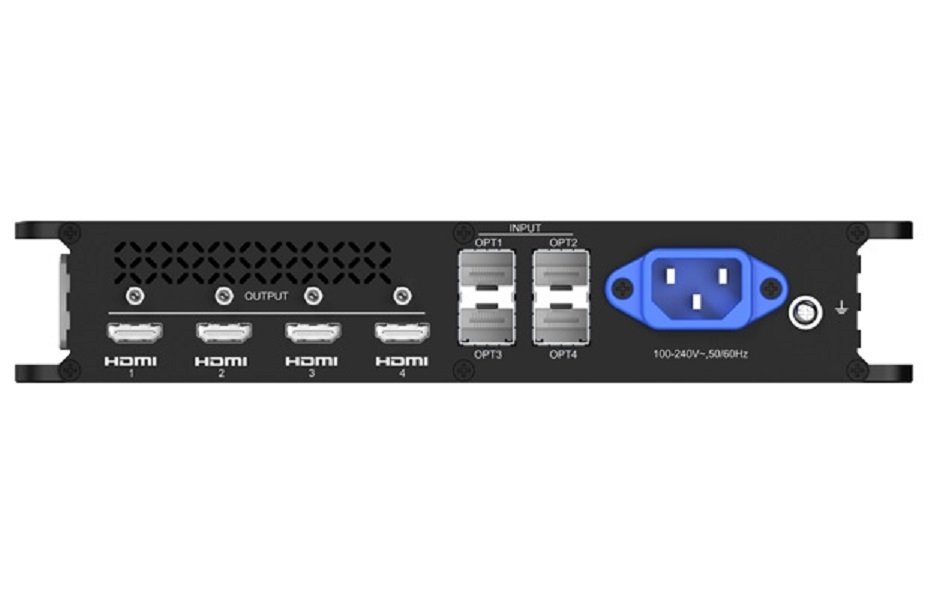
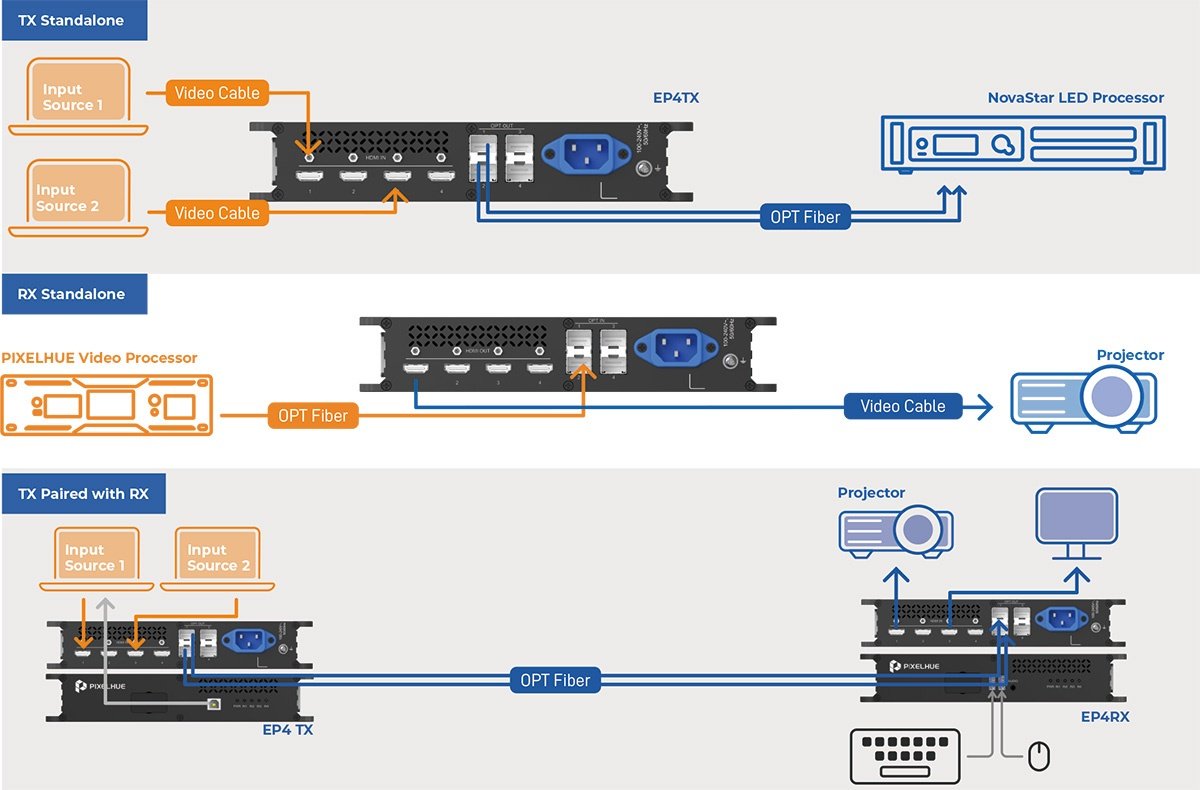
4 HDMI inputs — accepts up to four HDMI video sources (like cameras, media players, or computers).
4 fiber optic outputs — sends those video signals over fiber cables.
Video Quality
Supports 4K video resolution (3840×2160) at up to 60 Hz.
Compatible with HDR and 3D passthrough.
Handles standard HD resolutions as well.
Transmission
Converts HDMI signals into optical signals for long-distance transmission.
Works with corresponding fiber receivers that convert the signals back to HDMI at the display end.
Very low latency, meaning minimal delay between source and display.
Operation
Designed to be plug-and-play — no complex setup required.
Provides EDID management so displays and sources communicate properly.
Optical transmission is immune to electromagnetic interference.
Pixelhue EP4T — Technical Specifications
🔌 HDMI Inputs
Number of ports: 4 HDMI 2.0
Maximum supported resolution: Up to 3840×2160 @ 60 Hz (depending on mode)
Pixel width range: 800 to 8192
Pixel height range: 600 to 7680
Color depth: Up to 12-bit (supports 10-bit and 8-bit)
Color formats: RGB 4:4:4, YCbCr 4:4:4, YCbCr 4:2:2
At 4K60, YCbCr 4:2:0 is supported
Audio: Embedded audio (48 kHz) supported
HDR: Supported
3D video: Supported
HDCP: HDCP 2.2 compliant (backward compatible with HDCP 1.4)
💡 Fiber Optical Outputs
Number of optical ports: 4 optical outputs
Per-port bandwidth: ~10.3125 Gbps
Maximum video per port:
• Up to 3840×2160 @ 30 Hz individually
• Up to 3840×2160 @ 60 Hz when paired
Color formats: RGB and YCbCr (same as HDMI inputs)
Audio: Embedded audio supported
HDR & 3D: Supported
HDCP: HDCP 2.2 compliant (with HDCP 1.4 compatibility)
Typical fiber distance:
• Single-mode fiber — up to several kilometers
• Multi-mode fiber — up to a few hundred meters
Requires appropriate LC fiber connections
⚡ Power & Environment
Power input: 100–240 V AC, 50/60 Hz
Power consumption: ~22 W maximum
Operating temperature: 0 °C to +45 °C
Storage temperature: –20 °C to +60 °C
Operating humidity: 5%–85% non-condensing
Storage humidity: 5%–95% non-condensing
🧠 Features & Capabilities
Low or near-zero latency — ideal for real-time video
EDID management — ensures compatibility between sources and displays
Plug-and-play design — simple setup
HDR & 3D pass-through supported
Immune to EMI/RFI due to fiber transmission
Works with matching fiber receiver units to convert optical back to HDMI at displays
📦 Typical Uses
Suitable for:
Long-distance AV distribution where HDMI cables fall short
Live event and broadcast installations
Conference rooms and auditoriums
Digital signage networks
Control and monitoring rooms